
Learn What Is Digital Marketing? Types, Benefits & Career Opportunities with this complete guide covering SEO, PPC, social media, AI, salaries, skills, and future trends.
What Is Digital Marketing? Types, Benefits & Career Opportunities
If you’ve ever searched for a product on Google, watched a YouTube advertisement, clicked an Instagram promotion, received a promotional email, or purchased something after reading an online review, you’ve already experienced digital marketing in action. Today, businesses of every size—from local startups to global enterprises—depend on digital channels to connect with customers, build trust, and generate revenue.
But What Is Digital Marketing? Types, Benefits & Career Opportunities is more than just a beginner’s question. It is one of the most searched marketing topics because digital marketing has become the backbone of modern business growth.
Whether you’re a student planning your career, a business owner looking to increase sales, or a marketing professional aiming to upgrade your skills, understanding digital marketing is essential in today’s competitive online landscape.
Unlike traditional advertising methods such as newspapers, radio, or television, digital marketing enables brands to reach their target audience through multiple online channels with measurable results.
Companies can track website traffic, monitor customer engagement, measure Return on Investment (ROI), and optimize campaigns using advanced marketing analytics. This data-driven approach allows businesses to improve performance continuously while delivering highly personalized experiences to customers.
One of the biggest advantages of digital marketing is its flexibility. A business can attract visitors through Search Engine Optimization (SEO), increase visibility using Search Engine Marketing (SEM), drive instant leads with Pay-Per-Click (PPC) Advertising, engage audiences through Social Media Marketing (SMM)
nurture prospects using Email Marketing, expand reach with Influencer Marketing, and build trust through Content Marketing. Each strategy supports different stages of the customer journey, from awareness to conversion and long-term customer loyalty.
The rapid advancement of AI in Digital Marketing, marketing automation, and data-driven marketing has transformed how businesses understand consumer behavior. Artificial intelligence now helps marketers perform smarter keyword research, create personalized content, optimize advertising campaigns, automate customer communication, and improve overall marketing campaign optimization.
Digital marketing is also one of the fastest-growing career fields worldwide. Organizations across industries actively hire professionals skilled in Local SEO, Google Analytics, Performance Marketing, Conversion Rate Optimization (CRO), CRM (Customer Relationship Management), and digital advertising.
Whether your goal is to become a Digital Marketing Manager, freelance consultant, agency owner, SEO specialist, or e-commerce strategist, the opportunities continue to expand as more businesses invest in digital transformation.
In this comprehensive guide, you’ll learn What Is Digital Marketing? Types, Benefits & Career Opportunities, explore the most effective digital marketing channels, understand the essential skills employers seek, and discover why digital marketing remains one of the most rewarding and future-proof professions in the digital economy.
What Is Digital Marketing? Types, Benefits & Career Opportunities .
At its core, digital marketing is the practice of promoting products, services, or brands through digital technologies and internet-based platforms. It combines creativity, technology, analytics, and strategic communication to attract potential customers, generate leads, and drive measurable business growth.
Simply put, if a marketing activity happens online, it falls under digital marketing.
These digital channels include:
- Search engines like Google and Bing
- Social media platforms
- Email campaigns
- Business websites
- Mobile applications
- Video-sharing platforms
- E-commerce marketplaces
- Online communities
- Podcasts
- Affiliate websites
Unlike traditional marketing, digital marketing provides real-time insights into campaign performance. Businesses no longer rely on assumptions—they use measurable data to understand what works and what needs improvement.
For example:
Imagine a local fitness center launching a new membership program.
Instead of printing thousands of flyers, the business can:
- Optimize its website using On-Page SEO
- Rank higher in Search Engine Results Pages (SERPs) through effective Search Engine Optimization (SEO)
- Run Pay-Per-Click (PPC) Advertising campaigns to attract immediate visitors
- Publish workout guides through Content Marketing
- Build an engaged community with Social Media Marketing (SMM)
- Send personalized offers through Email Marketing
- Partner with local creators via Influencer Marketing
- Encourage referrals using Affiliate Marketing
- Share fitness tutorials using Video Marketing
- Reach smartphone users through Mobile Marketing
Every interaction contributes to moving potential customers through the marketing funnel, ultimately increasing lead generation, sales, and long-term customer relationships.
Why Digital Marketing Matters More Than Ever
Consumer behavior has changed dramatically over the past decade. Modern buyers no longer make purchasing decisions solely based on advertisements. Instead, they research products, compare reviews, watch videos, read blogs, and interact with brands across multiple digital touchpoints before making a purchase.
This shift has made omnichannel marketing a necessity rather than an option.
Today’s successful businesses understand that customers may discover a brand through:
- Google Search
- YouTube
- Email newsletters
- Podcasts
- Online reviews
A consistent experience across all these channels improves brand awareness, strengthens brand positioning, and enhances customer retention.
Businesses that leverage personalization, audience segmentation, and CRM (Customer Relationship Management) can deliver tailored messages based on customer preferences, purchase history, and online behavior. This personalized approach significantly improves customer satisfaction while increasing conversion rates.
Key Objectives of Digital Marketing
Digital marketing is not just about selling products. Its primary purpose is to build meaningful relationships with customers while supporting long-term business growth.
Some of the most important objectives include:
Increase Brand Awareness
Helping new audiences discover your products and services through strategic content distribution, social media, search engines, and digital advertising.
Generate Qualified Leads
Using optimized landing pages, engaging content, and targeted advertising campaigns to attract potential customers genuinely interested in your offerings.
Drive Organic Traffic
Implementing effective Search Engine Optimization (SEO) strategies, backlink building, and high-quality content to improve search rankings and attract visitors without relying solely on paid advertising.
Improve Customer Engagement
Encouraging meaningful interactions through blogs, videos, webinars, social media posts, email newsletters, and online communities.
Increase Website Traffic
Driving visitors through multiple channels including SEO, PPC campaigns, referral marketing, influencer collaborations, and video content.
Boost Sales and Revenue
Optimizing every stage of the conversion funnel using Conversion Rate Optimization (CRO), personalized experiences, and effective calls-to-action.
Build Customer Loyalty
Maintaining long-term relationships through excellent communication, personalized offers, valuable educational content, and exceptional customer support.
What Is Digital Marketing? Types, Benefits & Career Opportunities
Digital marketing is no longer limited to large corporations with massive advertising budgets. Today, startups, freelancers, local businesses, educational institutions, healthcare providers, and multinational companies all rely on digital marketing to remain competitive.
Some industries where digital marketing plays a critical role include:
- E-commerce
- Healthcare
- Education
- Finance
- Real Estate
- Hospitality
- Travel
- SaaS
- Manufacturing
- Automotive
- Fashion
- Food & Beverage
- Entertainment
- Professional Services
For example:
An online clothing store can use E-commerce Marketing strategies to attract visitors through SEO, retarget abandoned carts using PPC ads, recommend products through AI-powered personalization, and encourage repeat purchases via automated email campaigns.
Similarly, a local restaurant can improve visibility with Local SEO, manage customer reviews through Online Reputation Management (ORM), and attract nearby customers using Google Business Profile optimization.
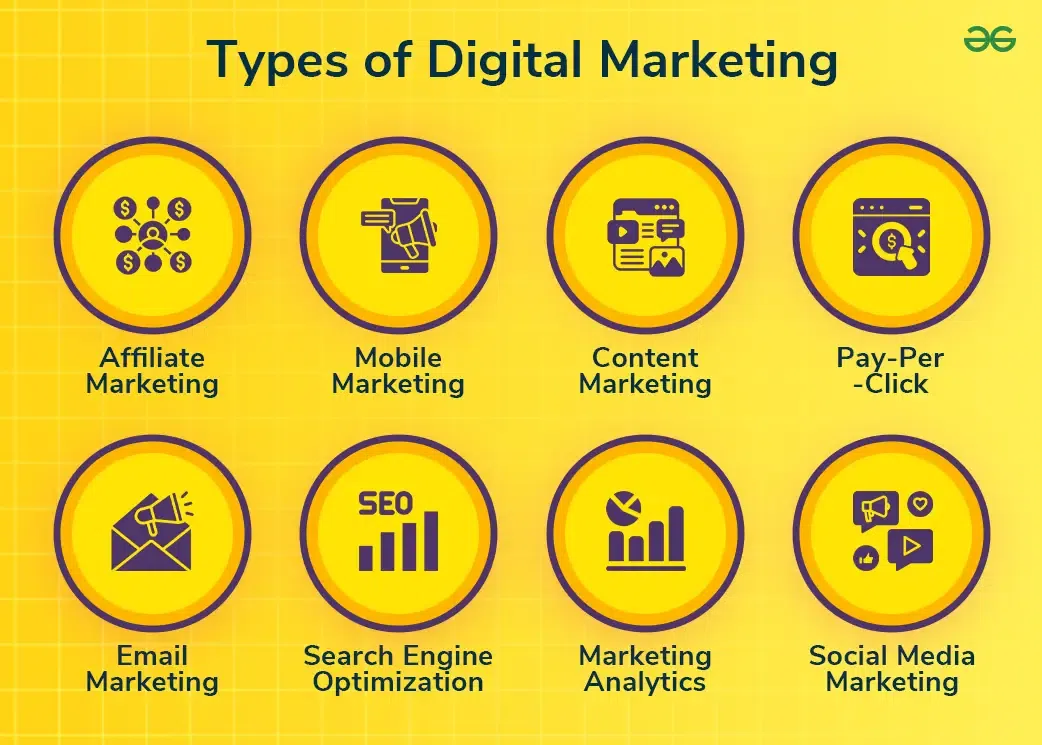
Types of Digital Marketing
Understanding the different types of digital marketing helps businesses choose the right channels based on their goals, budget, and audience. In most cases, the best results come from combining multiple channels into an integrated marketing strategy.
1. Search Engine Optimization (SEO)
Search Engine Optimization (SEO) is the process of improving a website so it ranks higher on search engines like Google and Bing. Higher rankings lead to more organic traffic, increased visibility, and greater trust.
SEO consists of several important components:
On-Page SEO
On-Page SEO focuses on optimizing individual web pages by improving:
- Title tags
- Meta descriptions
- Heading structure
- Internal linking
- Content quality
- Keyword placement
- Image optimization
- User experience
A well-optimized page answers user questions clearly while helping search engines understand its relevance.
Off-Page SEO
Off-page optimization strengthens a website’s authority through external signals. One of the most effective techniques is backlink building, where reputable websites link back to your content. High-quality backlinks signal trust and credibility to search engines.
Technical SEO
Technical SEO ensures that search engines can efficiently crawl, index, and understand your website. It includes:
- Website speed optimization
- Mobile responsiveness
- Secure HTTPS connections
- XML sitemaps
- Structured data
- Core Web Vitals
- Crawlability improvements
Together, these efforts help improve rankings on search engine results pages (SERPs).
2. Search Engine Marketing (SEM) and Pay-Per-Click (PPC) Advertising
While SEO generates long-term organic traffic, search engine marketing (SEM) helps businesses appear immediately in front of potential customers through paid advertisements.
The most common SEM model is pay-per-click (PPC) advertising, where advertisers pay only when someone clicks on their ad.
Popular PPC platforms include:
- Google Ads
- Microsoft Advertising
- YouTube Ads
- Shopping Ads
PPC campaigns are ideal for:
- Product launches
- Seasonal promotions
- Lead generation
- Brand awareness campaigns
- E-commerce sales
Successful PPC campaigns rely on:
- Strong keyword targeting
- High-quality landing pages
- Effective ad copy
- Audience segmentation
- Bid optimization
- Continuous performance monitoring
When managed correctly, PPC delivers immediate visibility while complementing long-term SEO efforts.
3. Content Marketing
At the heart of every successful digital marketing campaign lies content marketing.
Instead of directly selling products, businesses create valuable content that educates, entertains, or solves customer problems. This approach builds trust, attracts visitors, and positions the brand as an authority in its industry.
Content marketing includes:
- Blog articles
- Guides
- Case studies
- White papers
- Infographics
- Podcasts
- Webinars
- Downloadable resources
- Interactive tools
Quality content supports every stage of the marketing funnel—from awareness to consideration and decision-making.
Effective content distribution ensures that this content reaches the right audience through search engines, email newsletters, social media platforms, and partner websites.
Businesses that consistently publish valuable content often experience higher organic visibility, stronger customer relationships, and improved lead generation over time.

Types of Digital Marketing (Continued)
4. Social Media Marketing (SMM)
In today’s connected world, Social Media Marketing (SMM) has become one of the most powerful ways for businesses to reach potential customers, build communities, and increase brand visibility. Platforms such as Facebook, Instagram, LinkedIn, X (formerly Twitter), Pinterest, Snapchat, and TikTok enable businesses to interact directly with their audience while promoting products and services.
Unlike traditional advertising, social media allows two-way communication. Businesses can respond to comments, answer questions, gather feedback, and create meaningful relationships that improve customer engagement and long-term loyalty.
A successful social media strategy includes:
- Publishing valuable and consistent content
- Creating engaging visuals and short-form videos
- Responding to customer inquiries promptly
- Running paid social media campaigns
- Collaborating with creators
- Monitoring analytics and optimizing campaigns
One of the biggest advantages of SMM is its ability to increase brand awareness while driving qualified visitors to your website or online store.
Benefits of Social Media Marketing
- Builds brand trust and authority
- Increases website traffic
- Generates qualified leads
- Encourages customer interaction
- Supports customer service
- Improves search visibility indirectly
- Strengthens customer relationships
Businesses often integrate SMM with content marketing, video marketing, and email marketing to create a consistent experience across every customer touchpoint.
5. Email Marketing
Despite the rise of new digital channels, Email Marketing remains one of the highest-performing marketing methods in terms of Return on Investment (ROI).
Rather than sending generic promotional emails, modern businesses use personalized email campaigns to nurture relationships throughout the customer lifecycle.
Examples include:
- Welcome emails
- Product recommendations
- Weekly newsletters
- Promotional offers
- Educational content
- Cart abandonment reminders
- Customer feedback requests
- Re-engagement campaigns
Businesses often combine email marketing with Marketing Automation to deliver the right message at exactly the right time.
For example:
A visitor downloads a free eBook.
↓
The system automatically sends a welcome email.
↓
Three days later, the visitor receives helpful educational content.
↓
After a week, they receive a special discount.
↓
Finally, they become a paying customer.
This automated sequence improves customer retention, builds customer loyalty, and increases conversion rates without requiring manual follow-ups.
6. Affiliate Marketing
Affiliate Marketing is a performance-based marketing model where businesses reward affiliates for driving sales or leads through referral links.
Affiliates may include:
- Bloggers
- YouTubers
- Website owners
- Influencers
- Review websites
- Coupon platforms
Whenever someone purchases through an affiliate’s unique tracking link, the affiliate earns a commission.
This strategy benefits both businesses and affiliates:
For Businesses
- Low upfront advertising costs
- Pay only for actual results
- Increased product exposure
- Scalable sales growth
For Affiliates
- Passive income opportunities
- No inventory management
- Flexible work schedule
- Ability to promote multiple brands
Affiliate marketing has become one of the fastest-growing online business models, especially in industries such as software, finance, education, travel, and e-commerce.
7. Influencer Marketing
Consumers increasingly trust recommendations from real people more than traditional advertisements. This shift has made Influencer Marketing one of the most effective digital marketing strategies.
Influencers have built loyal communities around specific interests such as:
- Technology
- Beauty
- Fitness
- Fashion
- Gaming
- Finance
- Education
- Travel
- Food
Instead of promoting products through conventional advertisements, brands collaborate with influencers who naturally introduce products to their audience.
Influencer marketing helps businesses:
- Build credibility
- Reach niche audiences
- Increase brand awareness
- Generate qualified leads
- Improve customer engagement
- Drive conversions
Successful influencer campaigns focus on authenticity rather than aggressive promotion.
8. Video Marketing
Video has become one of the most engaging forms of online content. Businesses use Video Marketing to educate customers, showcase products, tell brand stories, and improve conversion rates.
Popular video formats include:
- Product demonstrations
- Tutorials
- Customer testimonials
- Behind-the-scenes videos
- Webinars
- Live streaming
- Short-form reels
- Educational explainers
Videos often increase the amount of time users spend on a website, improve customer understanding, and encourage social sharing.
Many businesses combine video marketing with SEO by optimizing titles, descriptions, transcripts, and thumbnails to increase discoverability.
9. Mobile Marketing
As smartphone usage continues to grow worldwide, Mobile Marketing has become an essential part of every digital marketing strategy.
Businesses connect with customers through:
- Mobile-friendly websites
- SMS campaigns
- Push notifications
- Mobile applications
- QR codes
- Location-based promotions
- Mobile search advertising
Google also prioritizes mobile-friendly websites through mobile-first indexing, making mobile optimization critical for SEO success.
A responsive website improves user experience while increasing conversion opportunities.
10. Marketing Automation
Managing multiple marketing campaigns manually becomes difficult as businesses grow. That’s where Marketing Automation helps.
Automation software performs repetitive marketing tasks automatically, including:
- Email campaigns
- Lead nurturing
- Customer segmentation
- CRM updates
- Social media scheduling
- Lead scoring
- Follow-up reminders
- Workflow management
Instead of manually sending hundreds of emails every day, automation software ensures each customer receives relevant communication based on their actions.
This improves efficiency while delivering a personalized customer experience.
Understanding the Customer Journey and Marketing Funnel
Every customer goes through a series of stages before making a purchase. Understanding this process allows marketers to deliver the right message at every step.
The Customer Journey typically consists of:
1. Awareness
The customer realizes they have a problem or need.
Marketing channels used:
- SEO
- Blog articles
- Social media
- Videos
- Paid advertising
Objective:
Increase Brand Awareness.
2. Consideration
The customer researches available solutions.
Businesses provide:
- Product comparisons
- Reviews
- Case studies
- Educational content
- Free resources
This stage builds trust and encourages Customer Engagement.
3. Decision
The customer is ready to buy.
Businesses use:
- Optimized Landing Pages
- Product demos
- Customer testimonials
- Limited-time offers
- PPC campaigns
These strategies improve Conversion Rate Optimization (CRO).
4. Retention
The relationship continues after purchase.
Businesses focus on:
- Excellent support
- Loyalty programs
- Personalized email campaigns
- Exclusive offers
The goal is improving Customer Retention and increasing Customer Loyalty.
Marketing Funnel vs Conversion Funnel
Although often used interchangeably, the Marketing Funnel and Conversion Funnel serve different purposes.
The marketing funnel focuses on attracting and nurturing potential customers throughout their buying journey.
The conversion funnel concentrates on turning interested visitors into paying customers by removing friction and improving user experience.
Businesses optimize every stage through:
- Better landing pages
- Faster websites
- Stronger calls to action
- Personalized messaging
- Simplified checkout processes
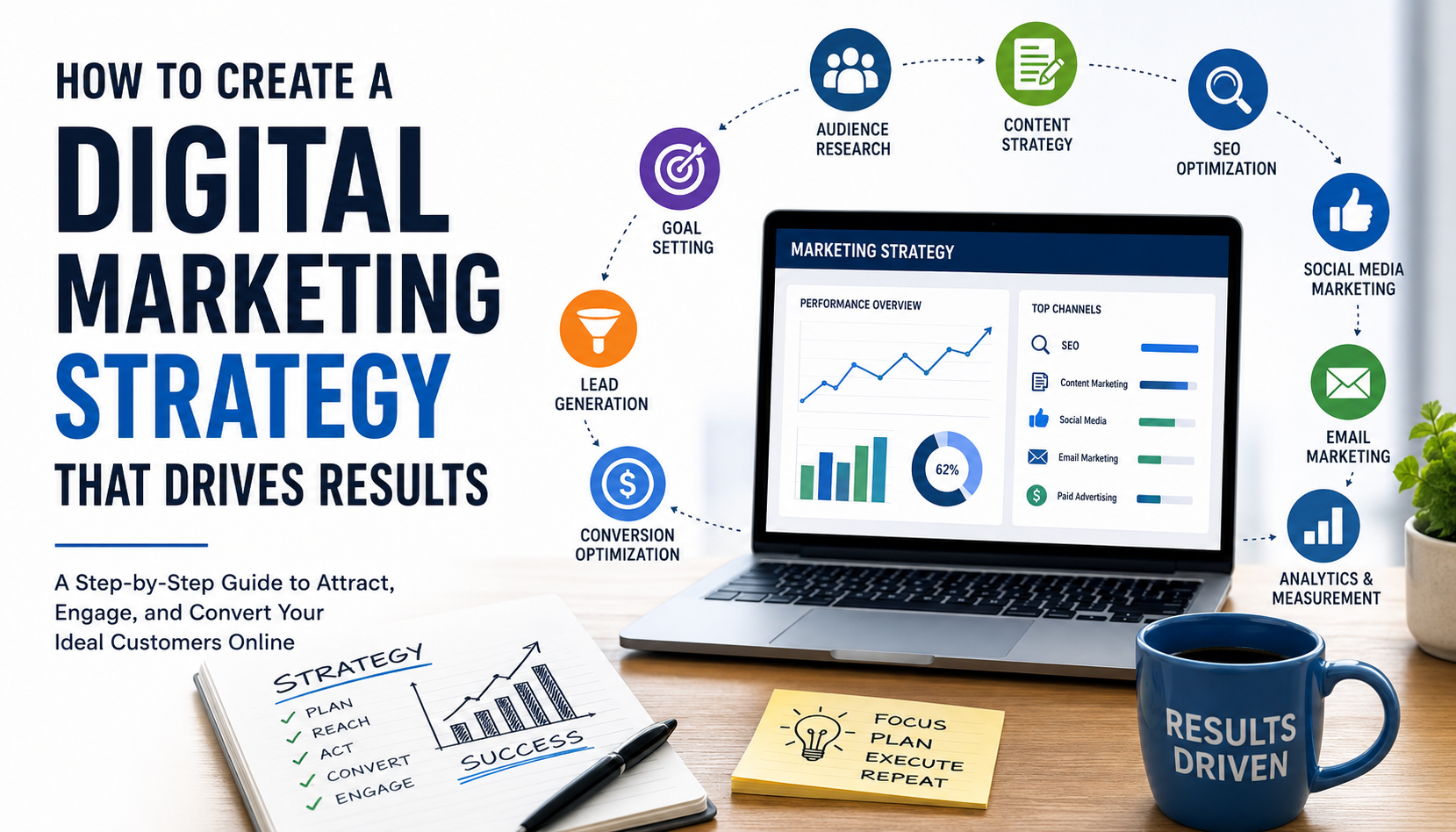
Building an Effective Digital Marketing Strategy
A successful Digital Marketing Strategy is more than publishing content or running advertisements. It combines multiple marketing channels into one coordinated plan.
An effective strategy typically follows these steps:
Define Your Target Audience
Every campaign begins with identifying the right Target Audience.
Consider factors such as:
- Age
- Location
- Income
- Interests
- Online behavior
- Purchasing habits
Understanding your audience helps create relevant messaging.
Develop a Buyer Persona
A Buyer Persona is a detailed representation of your ideal customer.
It includes:
- Demographics
- Goals
- Challenges
- Pain points
- Preferred communication channels
- Buying motivations
Personas help marketers create personalized campaigns that resonate with real customers.
Audience Segmentation
Not every customer has the same needs.
Through Audience Segmentation, businesses divide customers into groups based on:
- Demographics
- Interests
- Geography
- Purchase history
- Online behavior
This enables highly relevant and personalized marketing campaigns.
Personalization
Modern consumers expect brands to understand their preferences.
Personalization includes:
- Product recommendations
- Personalized emails
- Dynamic website content
- Customized advertisements
- Individualized offers
Personalized experiences often generate higher engagement and stronger customer relationships.
Omnichannel Marketing
Today’s customers interact with businesses across multiple devices and platforms.
Omnichannel Marketing creates a seamless experience whether customers visit:
- Websites
- Mobile apps
- Physical stores
- Social media
- Live chat
Every interaction should feel connected and consistent.
CRM (Customer Relationship Management)
A robust CRM (Customer Relationship Management) system helps businesses manage customer information, sales activities, communication history, and marketing campaigns from one central platform.
CRM systems support:
- Lead management
- Sales tracking
- Customer support
- Marketing automation
- Customer retention
- Relationship building
Businesses using CRM software can better understand customer needs while delivering more personalized experiences.
What Is Digital Marketing? Types, Benefits & Career Opportunities
Now that you understand what is digital marketing, types, benefits & career opportunities, let’s explore why millions of businesses are investing in digital marketing every year.
1. Reach the Right Audience
Unlike traditional marketing, digital marketing enables businesses to reach a highly specific target audience. Using audience segmentation, marketers can target customers based on:
- Age
- Gender
- Location
- Interests
- Online behavior
- Purchase history
- Device usage
This precision reduces wasted advertising spend and improves campaign effectiveness.
2. Generate High-Quality Leads
One of the biggest goals of digital marketing is lead generation.
Businesses can capture qualified leads through:
- SEO-optimized blogs
- Landing pages
- Free eBooks
- Webinars
- Contact forms
- Email subscriptions
- Paid advertising
Higher-quality leads often result in better conversion rates and increased revenue.
3. Increase Website Traffic
An effective digital marketing strategy helps businesses attract both paid and organic traffic through multiple channels, including:
- Search Engine Optimization (SEO)
- Content Marketing
- Social Media Marketing
- Email Marketing
- Pay-Per-Click (PPC) Advertising
- Video Marketing
A diversified traffic strategy reduces dependence on any single platform.
4. Improve Conversion Rates
Driving visitors to a website is only the first step. Businesses also need to convert those visitors into customers.
Conversion Rate Optimization (CRO) focuses on improving user experience by:
- Simplifying navigation
- Optimizing landing pages
- Improving page speed
- Writing compelling calls to action
- Running A/B tests
- Reducing checkout friction
Even small improvements in conversion rates can significantly increase revenue.
5. Build Long-Term Customer Relationships
Digital marketing doesn’t end after a purchase.
Through Email Marketing, CRM (Customer Relationship Management) systems, personalized recommendations, and loyalty programs, businesses can improve:
- Customer Engagement
- Customer Retention
- Customer Loyalty
Retaining existing customers is often more cost-effective than acquiring new ones.
Measuring Success with Marketing Analytics
One of digital marketing’s greatest strengths is its measurability.
Using Marketing Analytics, businesses can evaluate campaign performance and make informed decisions based on real data rather than assumptions.
Common metrics include:
- Website Traffic
- Conversion Rate
- Bounce Rate
- Click-Through Rate (CTR)
- Cost Per Click (CPC)
- Customer Acquisition Cost (CAC)
- Customer Lifetime Value (CLV)
These insights help marketers refine campaigns and improve overall performance.
Google Analytics
Google Analytics is one of the most widely used tools for tracking website performance.
It helps businesses understand:
- Visitor demographics
- Traffic sources
- User behavior
- Most-visited pages
- Conversion paths
- Goal completions
These insights enable businesses to optimize content and improve the overall user experience.
Key Performance Indicators (KPIs)
Every digital marketing campaign should be measured using relevant Key Performance Indicators (KPIs).
Examples include:
- Organic traffic growth
- Lead generation
- Conversion rate
- Revenue generated
- Return on Investment (ROI)
- Email open rate
- Click-through rate
- Customer retention rate
Choosing the right KPIs ensures marketing efforts align with business objectives.
Return on Investment (ROI)
One of the biggest advantages of digital marketing is the ability to calculate Return on Investment (ROI).
ROI measures how much revenue is generated compared to the amount spent on marketing activities.
Businesses that consistently monitor ROI can allocate budgets more effectively and maximize profitability.
Advanced Digital Marketing Concepts
AI in Digital Marketing
Artificial Intelligence is transforming the marketing landscape.
AI in Digital Marketing enables businesses to:
- Generate content ideas
- Personalize customer experiences
- Predict consumer behavior
- Automate repetitive tasks
- Optimize advertising campaigns
- Improve customer support through chatbots
AI-powered tools also help marketers analyze large datasets quickly, making campaigns more efficient and data-driven.
Data-Driven Marketing
Modern marketing decisions should rely on evidence, not guesswork.
Data-Driven Marketing uses analytics, customer insights, and behavioral data to create more effective campaigns.
Benefits include:
- Better audience targeting
- Improved personalization
- Higher conversion rates
- Smarter budget allocation
Marketing Campaign Optimization
Successful marketers continuously improve campaign performance through Marketing Campaign Optimization.
Optimization involves:
- Testing headlines and ad copy
- Refining audience targeting
- Improving landing pages
- Adjusting bids in PPC campaigns
- Enhancing email subject lines
- Updating SEO content
Continuous optimization ensures better results over time.
Performance Marketing
Performance Marketing focuses on measurable outcomes such as:
- Clicks
- Leads
- Sales
- App installs
- Conversions
Unlike traditional advertising, businesses pay based on actual results, making it a cost-effective strategy for growth.
Online Reputation Management (ORM)
Your brand’s online reputation can significantly influence purchasing decisions.
Online Reputation Management (ORM) involves:
- Monitoring customer reviews
- Responding to feedback
- Addressing complaints
- Managing brand mentions
- Building trust across digital platforms
A strong online reputation enhances credibility and customer confidence.
E-commerce Marketing
For online retailers, E-commerce Marketing combines multiple digital channels to increase sales.
Common strategies include:
- SEO for product pages
- Shopping ads
- Email campaigns
- Retargeting ads
- Influencer partnerships
- Social commerce
- Personalized product recommendations
These tactics help attract visitors, recover abandoned carts, and improve customer lifetime value.
Career Opportunities in Digital Marketing
As businesses continue to expand online, the demand for skilled digital marketers is growing rapidly.
Popular Career Opportunities in Digital Marketing include:
- SEO Specialist
- Content Marketer
- Social Media Manager
- PPC Specialist
- Email Marketing Specialist
- Affiliate Marketing Manager
- Influencer Marketing Manager
- Marketing Automation Specialist
- Data Analyst
- Web Analytics Specialist
- E-commerce Marketing Manager
- CRM Manager
- Digital Marketing Executive
- Performance Marketing Manager
- Digital Marketing Consultant
- Digital Marketing Trainer
- Freelance Digital Marketer
- Agency Owner
- Growth Marketer
- Digital Marketing Manager
Digital Marketing Manager
A Digital Marketing Manager oversees the planning, execution, and optimization of online marketing campaigns.
Typical responsibilities include:
- Developing digital marketing strategies
- Managing SEO and PPC campaigns
- Leading content marketing initiatives
- Coordinating social media efforts
- Tracking KPIs and ROI
- Managing marketing budgets
- Collaborating with design and development teams
- Improving customer acquisition and retention
To succeed in this role, professionals need a combination of analytical thinking, creativity, communication skills, and technical knowledge.
Conclusion
Digital marketing has become an essential part of modern business growth. From Search Engine Optimization (SEO) and Content Marketing to Social Media Marketing (SMM), Email Marketing, Search Engine Marketing (SEM), and Pay-Per-Click (PPC) Advertising, every channel plays a role in reaching and converting customers.
By understanding the customer journey, creating valuable content, optimizing campaigns with data, and embracing technologies like AI in Digital Marketing, businesses can build stronger relationships, increase visibility, and achieve sustainable growth.
Whether you’re a student exploring career opportunities in digital marketing, an entrepreneur looking to grow your business, or a professional planning to upgrade your skills, now is the perfect time to invest in digital marketing knowledge.
The digital world is constantly evolving, but the principles remain the same: understand your audience, provide value, measure results, and keep improving.
FAQs: What Is Digital Marketing? Types, Benefits & Career Opportunities.
1. What is digital marketing?
Digital marketing is the promotion of products or services using online channels such as search engines, social media, email, websites, and digital advertising.
2. Why is digital marketing important?
It helps businesses reach targeted audiences, generate leads, increase sales, and measure results accurately.
3. What are the main types of digital marketing?
SEO, SEM, PPC, Content Marketing, Social Media Marketing, Email Marketing, Affiliate Marketing, Influencer Marketing, Video Marketing, and Mobile Marketing.
4. What is SEO in digital marketing?
SEO is the process of optimizing websites to improve rankings on search engines and increase organic traffic.
5. What is SEM?
Search Engine Marketing uses paid advertisements to improve visibility on search engines.
6. What is PPC advertising?
PPC is an advertising model where advertisers pay only when users click on their ads.
7. What is content marketing?
Content marketing involves creating valuable content to attract, educate, and convert potential customers.
8. What is social media marketing?
It involves promoting brands through social media platforms to increase engagement and awareness.
9. How does email marketing work?
Email marketing delivers personalized messages to nurture leads, promote products, and retain customers.
10. What is affiliate marketing?
Affiliate marketing rewards partners for generating sales or leads through referral links.
11. What is influencer marketing?
Influencer marketing uses trusted creators to promote products to their audiences.
12. What is marketing automation?
Marketing automation uses software to automate repetitive marketing tasks such as email campaigns and lead nurturing.
13. What is Google Analytics?
Google Analytics is a tool that tracks website performance and visitor behavior.
14. What is conversion rate optimization (CRO)?
CRO improves website elements to increase the percentage of visitors who complete desired actions.
15. What are KPIs in digital marketing?
KPIs are measurable metrics used to evaluate campaign performance.
16. What is ROI in digital marketing?
ROI measures the profitability of marketing campaigns by comparing revenue to costs.
17. What skills are required for digital marketing?
SEO, content writing, analytics, PPC, social media management, communication, and data analysis.
18. Is digital marketing a good career?
Yes. It offers high demand, competitive salaries, remote work opportunities, freelancing, and entrepreneurship.
19. How long does it take to learn digital marketing?
Basic concepts can be learned in a few months, while mastering advanced skills requires continuous learning and practical experience.
20. What is the future of digital marketing?
The future includes AI-powered marketing, personalization, automation, voice search optimization, privacy-focused strategies, and data-driven decision-making.
What Is Digital Marketing? Types, Benefits & Career Opportunities
| Digital Marketing Channel | Primary Goal | Best For | Time to See Results |
|---|---|---|---|
| Search Engine Optimization (SEO) | Increase Organic Traffic | Long-term Growth | 3–6 Months |
| Search Engine Marketing (SEM) | Instant Visibility | Quick Leads | Immediate |
| Pay-Per-Click (PPC) Advertising | Paid Customer Acquisition | Businesses of All Sizes | Immediate |
| Content Marketing | Build Trust & Authority | Lead Generation | 3–12 Months |
| Social Media Marketing (SMM) | Brand Awareness & Engagement | Community Building | 1–3 Months |
| Email Marketing | Customer Retention | Existing Customers | Immediate |
| Affiliate Marketing | Increase Sales | E-commerce & SaaS | 2–6 Months |
| Influencer Marketing | Brand Exposure | Consumer Brands | 1–3 Months |
| Video Marketing | Customer Education | High Engagement | 1–6 Months |
| Mobile Marketing | Reach Mobile Users | Local & Online Businesses | Immediate |
Advantages of Digital Marketing
Digital marketing provides several advantages over traditional marketing, making it one of the most effective ways to grow a business in today’s digital-first world.
Increased Online Visibility
With proper Search Engine Optimization (SEO), businesses can rank higher on search engines, making it easier for potential customers to discover their products and services.
Cost-Effective Marketing
Compared to television, print, or radio advertising, digital marketing offers affordable options that suit businesses of every size.
Better Customer Targeting
Through Audience Segmentation and Buyer Persona research, businesses can reach the right people with personalized messages.
Higher Conversion Rates
Optimized Landing Pages, compelling calls to action, and Conversion Rate Optimization (CRO) techniques help convert visitors into customers.
Real-Time Performance Monitoring
Tools like Google Analytics and other Marketing Analytics platforms allow businesses to monitor campaigns instantly and make data-driven improvements.
Challenges of Digital Marketing
Although digital marketing offers enormous opportunities, businesses also face several challenges.
Increasing Competition
Millions of businesses compete for visibility across search engines and social media platforms.
Frequent Algorithm Updates
Google and social media platforms regularly update their algorithms, requiring marketers to adapt their strategies.
Content Saturation
Creating unique, high-quality content is more important than ever because users have countless choices online.
Data Privacy Regulations
Businesses must comply with regulations related to user privacy, cookies, and consent when collecting customer data.
Continuous Learning
Digital marketing evolves rapidly. Professionals must stay updated with new tools, AI technologies, and industry trends.
Best Digital Marketing Tools
SEO Tools
- Google Search Console
- Google Keyword Planner
- Ahrefs
- Semrush
- Screaming Frog
PPC Tools
- Google Ads
- Microsoft Advertising
- Meta Ads Manager
Social Media Tools
- Buffer
- Hootsuite
- Later
Email Marketing Tools
- Mailchimp
- Brevo
- ConvertKit
CRM Tools
- Salesforce
- HubSpot CRM
- Zoho CRM
Marketing Automation Tools
- HubSpot
- ActiveCampaign
- Mailchimp Automation
Analytics Tools
- Google Analytics 4 (GA4)
- Google Tag Manager
- Microsoft Clarity
- Looker Studio
Future Trends in Digital Marketing
The digital marketing landscape continues to evolve rapidly. Businesses that embrace emerging technologies will gain a competitive advantage.
Artificial Intelligence (AI)
AI is transforming content creation, personalization, predictive analytics, customer support, and campaign optimization.
Voice Search Optimization
With the increasing use of smart assistants, optimizing content for conversational search queries is becoming more important.
Video-First Marketing
Short-form videos, live streaming, and interactive video content continue to dominate user engagement.
Hyper-Personalization
Businesses increasingly use customer data to deliver tailored experiences across websites, emails, and advertisements.
Privacy-First Marketing
As third-party cookies decline, brands are focusing on first-party data, transparency, and user trust.
Omnichannel Customer Experiences
Customers expect seamless interactions across websites, mobile apps, social media, email, and physical stores.
Key Takeaways
- Digital marketing is essential for businesses of all sizes.
- SEO delivers sustainable long-term organic traffic.
- SEM and PPC provide immediate visibility and faster lead generation.
- Content marketing builds trust and authority.
- Social media strengthens customer engagement and brand awareness.
- Email marketing remains one of the highest-ROI channels.
- Marketing analytics and KPIs help optimize campaigns based on real data.
- AI and automation are shaping the future of digital marketing.
- Continuous learning is essential because the digital landscape evolves rapidly.
- A well-planned digital marketing strategy combines multiple channels for the best results.
Internal Linking Suggestions
To strengthen topical authority and improve user navigation, link this article to related content such as:
- Complete SEO Guide for Beginners
- What Is Search Engine Optimization (SEO)?
- What Is Content Marketing?
- Google Ads Beginner’s Guide
- Social Media Marketing Strategy
- Email Marketing Best Practices
- Local SEO Checklist
- Keyword Research Guide
- AI in Digital Marketing
- How to Start a Career in Digital Marketing
Suggested External References
For credibility and further reading, consider linking to:
- Google Search Central (SEO documentation)
- Google Analytics Help Center
- Google Ads Help Center
- HubSpot Marketing Resources
- Salesforce Marketing Resources
- Semrush Blog
- Ahrefs Blog
- Meta Business Help Center
Featured Snippet Answer
What Is Digital Marketing?
Digital marketing is the practice of promoting products or services using online channels such as search engines, social media, email, websites, and paid advertising. It helps businesses attract targeted audiences, generate leads, improve customer engagement, measure campaign performance, and increase sales through data-driven strategies.
Final Call to Action
Digital marketing is no longer optional—it’s a core driver of business growth in the digital age. Whether you’re a student, entrepreneur, freelancer, or business owner, building expertise in SEO, content marketing, paid advertising, analytics, and AI-powered marketing can create long-term opportunities. Start by mastering one channel, apply what you learn through real projects, and continuously refine your strategy based on data and customer feedback. The sooner you begin, the stronger your digital presence and career prospects will become.
Follow Me On Instagram
For More Info. Contact Us
